
San Luis Obispo County Wanted History
No verified, standing sheriff's gallery exists for San Luis Obispo County. No reliable count of current listings does either. What the record does show is a program called Most Wanted Wednesday. Sheriff Records & Warrants handed over a featured warrant each week, and the sheriff's app announcement described every feature as a wanted person paired with alleged crimes. Some posts include an identifying image, since the goal is finding someone. That is not a booking-photo feed. Nor does it mean the person has passed through the San Luis Obispo County Jail.
For history, turn to the sheriff's 2019 annual report. It counted 51 featured warrants that year. It reported 38 cleared. Those figures prove the campaign ran and produced real results in 2019. They prove nothing about today. Weekly posts may have slowed, names may have changed, and any listing can end after a court appearance, an arrest, or a recall. So before trusting a saved or shared post, check its date and the account that published it.
San Luis Obispo County Wanted Fields
The sheriff's app announcement confirms only a bare format. Each notice names a featured person, lists the crimes involved, and asks the public for help. Some posts add more identifying details. Don't count on it, though. A physical description, a caution flag, a reward, or a last known location may or may not appear on any given notice. Trust only what the issuing notice actually says.
| Field | What it means |
|---|---|
| Name | The identity used in the sheriff's feature; compare spelling carefully. |
| Identifying image | An agency-selected aid for locating the person, not a hosted photo gallery. |
| Alleged crimes | The stated basis associated with the notice, still subject to court review. |
| Post date | A clue to age, not proof that the person remains wanted today. |
| Tip route | The official way to pass information without confronting the person. |
A wanted image is not a routine arrest photo under California publication rules. Different rules apply. Ongoing safety needs can justify keeping it public while the person is still being sought. The agency itself controls the post and its status. Copies that spread elsewhere are another matter entirely. They may stick around long after the active warrant is gone.
Note: An undated screenshot, cached result, or repost stripped of the sheriff's original context tells you nothing about current status.
Use County Wanted Notices Safely
Go to the official source first. Then hand everything to law enforcement. Surveillance, pursuit, or confronting the person yourself plays no part in a responsible response. A tip might point to a place, a vehicle, a time, or something you observed. Whether it fits the case is a call only the agency can make.
- Open the current sheriff app or verified Sheriff-Coroner social channel. Check the post date and confirm that San Luis Obispo County issued it.
- Read the name, alleged offenses, image, and any agency caution exactly as published. Do not add claims from comments or copied posts.
- If the person is seen, move to a safe place. Do not approach, confront, follow, warn, touch, or try to detain them.
- Send facts through law enforcement or San Luis Obispo County Crime Stoppers. For an urgent threat, call 911.
- Recheck official status before repeating an old notice. A cleared warrant can leave stale copies online.
Booking changes the picture. Once the person is booked, the wanted post is no longer the right place to check custody. Go elsewhere for that. Use the San Luis Obispo County booking and roster paths instead, which separate a recent booking from current jail custody. A booking entry reflects only the front end of the case, though, not its final result.
San Luis Obispo County Wanted Tips
Crime Stoppers is the tip route San Luis Obispo County actually promotes. Anyone with information on a wanted person can call it in or use its web portal. Anonymity and reward rules shift from time to time. Check the current Crime Stoppers site for whatever terms apply before you count on either one. When you call, stick to what you saw yourself. Rumors and guesses about who did what just waste the operator's time.
San Luis Obispo County Crime Stoppers
Tip line: (805) 549-STOP
Online: Crime Stoppers tip portal
Emergency: Call 911 when there is an immediate threat.
Good tips share a few things. Say what you personally witnessed, when it happened, and exactly where. A direction of travel helps too. Skip the urge to post it on social media first. Public replies can reveal who you are, spread a wrong identification, or tip off the fugitive before police can act.
Check San Luis Obispo County Warrants
San Luis Obispo County has no public portal for searching warrants by name. The information is sensitive. So the county keeps it controlled. Sheriff Records & Warrants holds the records, and local guidance says the subject of a warrant may learn about it by appearing in person with identification. A court case search can surface a warrant tied to that case, but that is far from a full county index.
The Sheriff Records and Warrants FAQ is the official starting point.
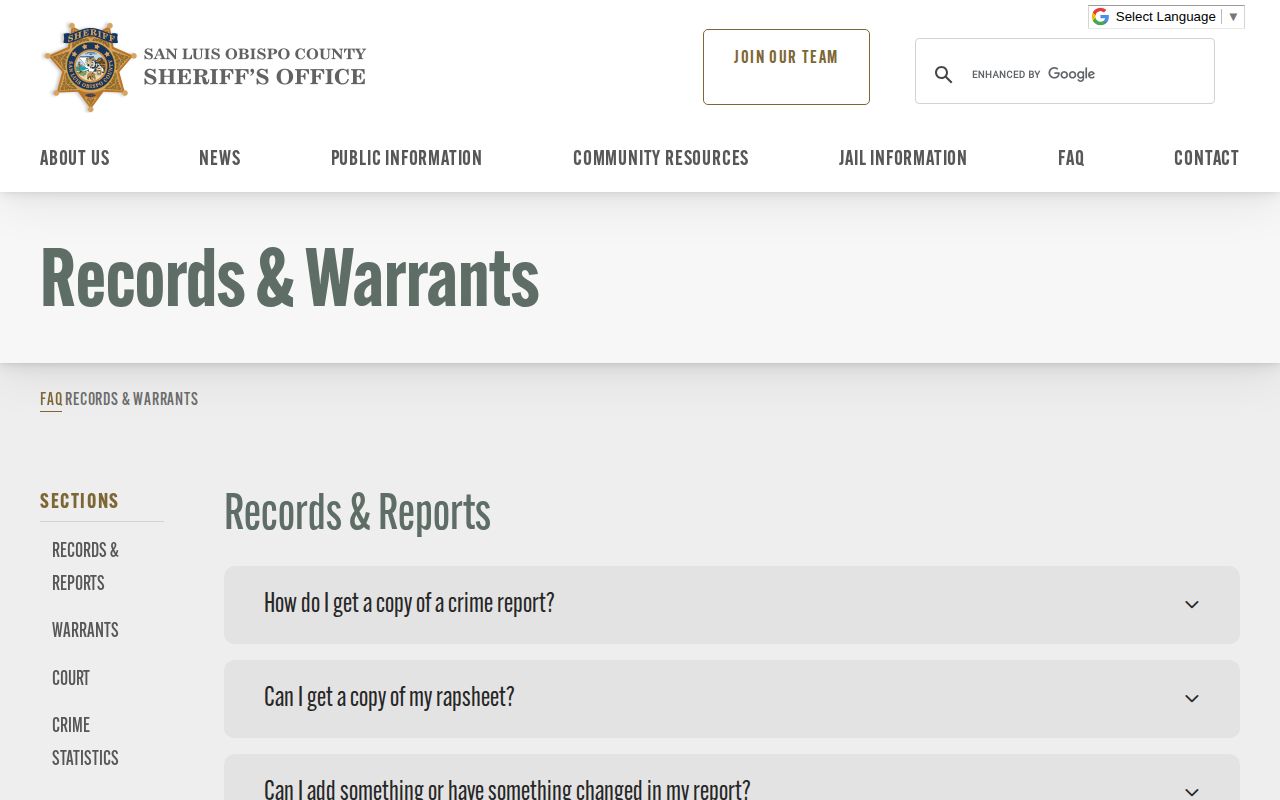
The county runs this as a direct records-unit check rather than an anonymous database lookup. Handle it yourself. Asking a friend or an unofficial site to infer your status only invites confusion.
- Gather the exact legal name and any known court case details. Similar names can lead to a harmful mismatch.
- Call Sheriff Records & Warrants at (805) 781-4588 during its published weekday hours and ask what identity process applies.
- If directed to appear, bring government identification. Do not assume that staff can disclose the answer to an unrelated caller.
- Check a known public criminal case through the Superior Court to see whether its docket reflects warrant activity. Treat that as case-specific, not complete.
- If the warrant may concern you, contact a lawyer, the issuing court, or Records & Warrants to plan a safe resolution.
Think of this path as verification and resolution. It is not a way to dodge service or an arrest. The Records & Warrants office sits at 1585 Kansas Avenue in San Luis Obispo. Hours run Monday through Friday, 8:00 a.m. to 5:00 p.m.
San Luis Obispo County Warrant Types
Warrants come in several varieties, each with its own reason for existing. The type tells you which court or agency can explain what happens next. At its core, a warrant is a judge's command to bring someone before a court or to authorize an arrest.
| Type or context | Best verification path | What not to assume |
|---|---|---|
| Arrest warrant | Sheriff Records & Warrants, an attorney, or the issuing court | That the person has already been booked |
| Bench warrant | The court handling the case, plus Records & Warrants | That the underlying charge was proved |
| Wanted feature | The dated sheriff post and Crime Stoppers for tips | That it represents every county warrant |
| Public case notation | The Superior Court docket and actual case documents | That the court search covers unrelated warrants |
When someone is arrested in California, the law says they go before a magistrate quickly. Sundays, holidays, and the court calendar can stretch that window a bit, but the requirement stands. San Luis Obispo County sends all felony arraignments, plus in-custody misdemeanor arraignments, to the courthouse in San Luis Obispo. At an arraignment, the charges get read aloud, and questions about pleas and lawyers come first. Charges can change later, too. They may be amended, cut down, dropped, or never filed at all.
For case details and copies, the Superior Court criminal case request page lays out the local process step by step.
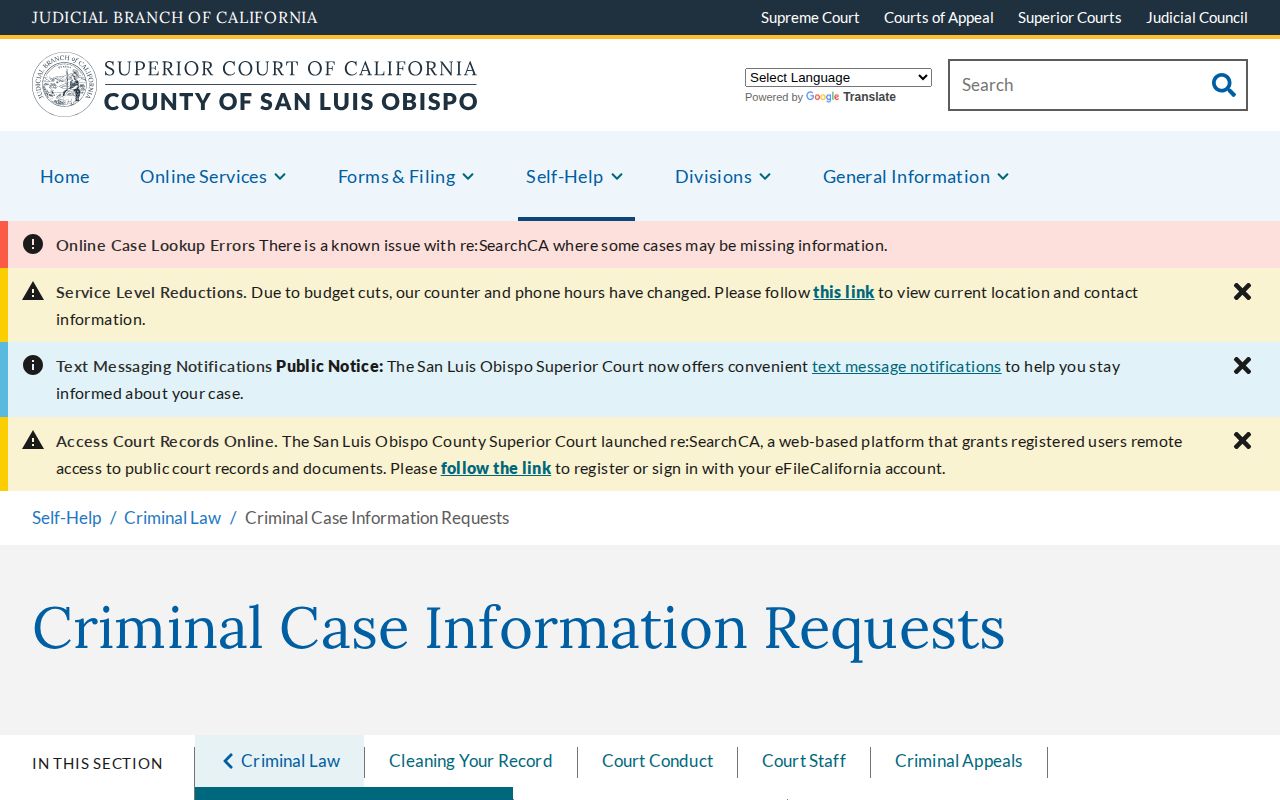
That court channel works well once you already know a case exists. It cannot replace the Sheriff's full warrant repository. Protected matters stay hidden from it as well.
Note: A case outcome from the Superior Court carries more weight than an old wanted post.
San Luis Obispo County Wanted App
The Sheriff's Office runs an official app called "San Luis Obispo CA Sheriff." It bundles several tools in one download. Most Wanted Wednesday posts, inmate information, press releases, push notices, emergency alerts, and program news all live there, though each works on its own. The announcement never promises booking photos in the inmate section. An alert, for its part, is not a court record.
The Sheriff's app announcement describes the wanted feature and the alert tools.
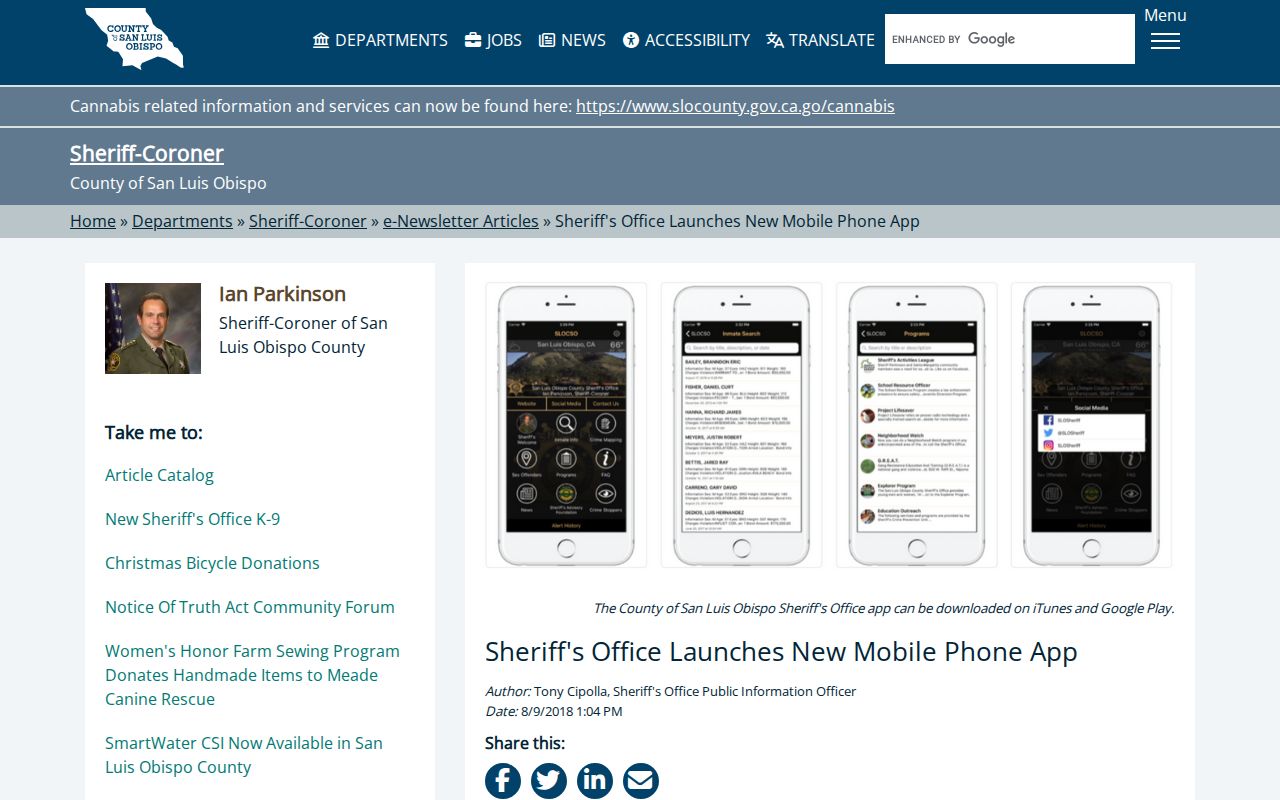
The announcement shows how the program was built. It says nothing firm about today's posting schedule. For current listings, check Google Play or the Apple App Store. Before acting on any wanted notice, confirm it with the sheriff first.
When a County Warrant Clears
A cleared warrant moves a record into its next stage. An arrest that ends in jail booking will surface in the booking log after its stated delay. A court appearance without a new jail stay shows up only in the case docket, and a social media post may simply vanish while the official record lives on.
California law also limits what police and sheriff agencies can post. Penal Code section 13665 requires removal of arrest images within 14 days in many cases, unless a public-safety exception applies. An active fugitive search is one such exception. So an old San Luis Obispo County wanted image can disappear without warning. That removal does not erase the warrant, close the case, or update every outside copy floating around.
The San Luis Obispo Superior Court record-clearing page spells out the official relief paths available once a case reaches the right stage.
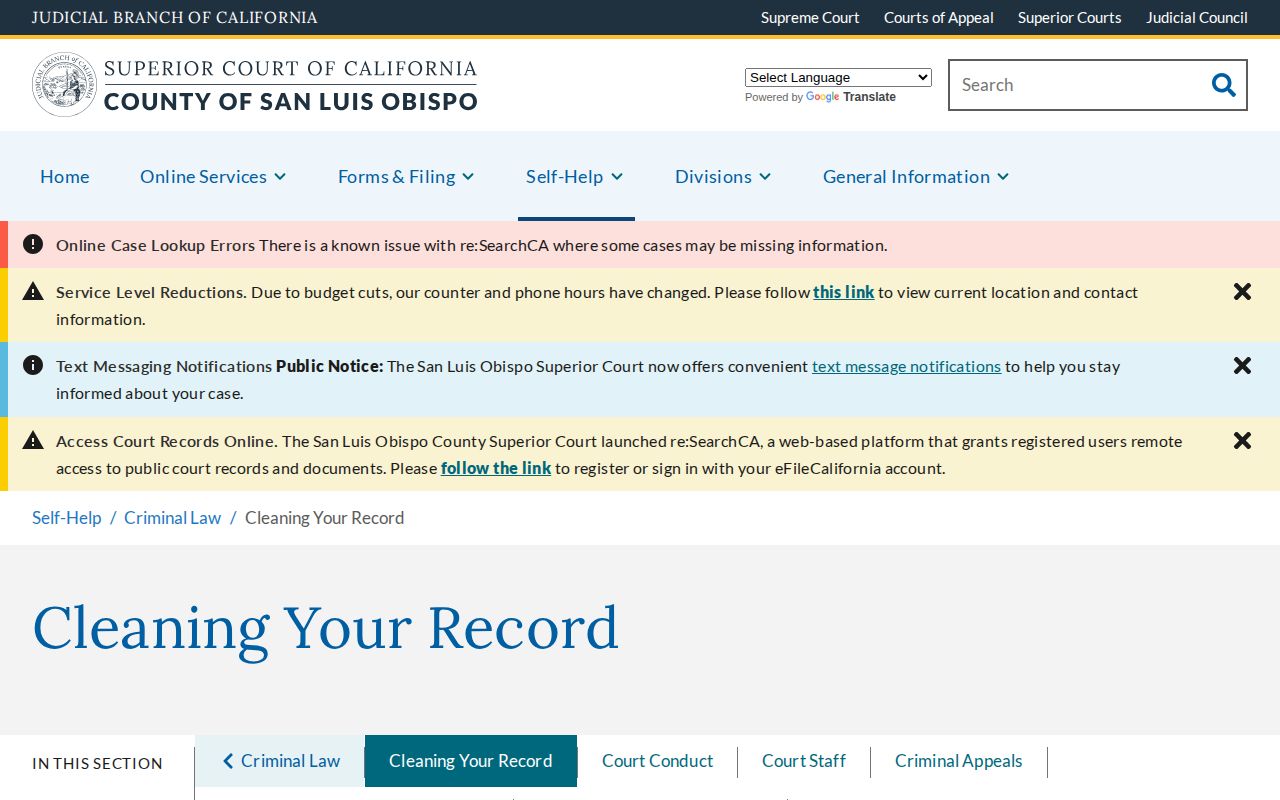
The court's record-clearing page covers legal relief only. It is not a shortcut for changing a live wanted notice. Eligibility and effect depend on the case and the court's order.
If a case touches you directly, work through a lawyer, the court, and Records & Warrants. Everyone else should send tips to law enforcement. A wanted post is never a stand-in for a real warrant check, a custody confirmation, or a court disposition.